Double Deep Pallet Racking
Double deep pallet racking stores pallets two-deep on each side of the aisle, effectively doubling storage density while...
Double Deep Pallet Racking
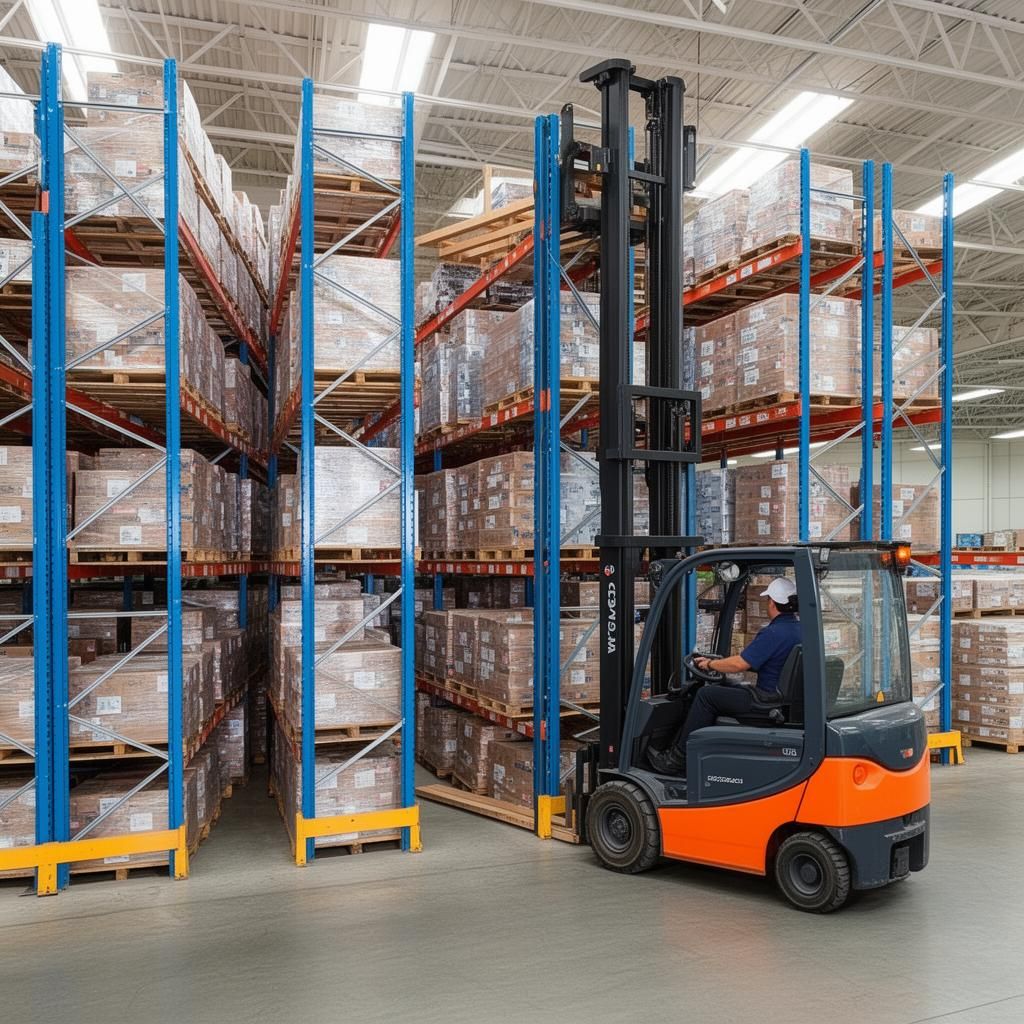
Double deep pallet racking stores pallets two-deep on each side of the aisle, effectively doubling storage density while maintaining reasonable access. This system is ideal for warehouses with medium SKU counts and uses specialized deep-reach forklifts.
- Double storage density
- Medium SKU optimization
- Deep-reach forklift access
- Cost-effective solution
Overview
Double deep pallet racking is a high-density storage solution that increases warehouse capacity by storing pallets two deep on each side of the aisle. This effectively doubles the number of pallet positions compared to single-deep selective racking while reducing the number of aisles needed by approximately 50%.
This system strikes an excellent balance between storage density and selectivity, making it ideal for warehouses with a moderate number of SKUs where each SKU has multiple pallets in inventory. While the rear pallet in each pair is not directly accessible (requiring the front pallet to be removed first), the system still provides good stock rotation when managed properly.
Double deep racking uses deep-reach forklifts with telescopic forks that can extend to place or retrieve pallets in the second position. These specialized trucks are widely available in the UAE market and represent a relatively modest investment compared to the significant storage density gains they enable.
System Operation & Mechanics
Double deep racking uses the same structural components as selective pallet racking—uprights, beams, and bracing—but the frames are arranged in back-to-back pairs rather than single rows. This creates two pallet-deep storage positions on each side of the aisle.
Deep-reach forklifts feature telescopic fork carriages that can extend approximately 1,200mm beyond the standard reach position to access the rear pallet. The operator first places or retrieves the front pallet normally, then extends the forks to reach the second position. This operation adds only a few seconds to each put-away or retrieval cycle.
The system is typically configured with 3 or 4 beam levels, providing 6 to 8 pallets per bay face (compared to 3 to 4 in single-deep racking). Aisle widths are similar to reach truck operations at approximately 2,800mm to 3,200mm.
Advantages
Key Benefits
Double Storage Density
Store twice as many pallets compared to single-deep selective racking by utilizing back-to-back frame configurations.
Fewer Aisles Required
Reduce the number of working aisles by up to 50%, freeing valuable floor space for other warehouse functions.
Cost-Effective Density
Achieve significant density gains at only 15-20% more cost than standard selective racking, making it one of the most economical high-density solutions.
Good Selectivity
While not 100% selective like single-deep racking, the system provides access to 50% of pallets at any time—sufficient for most medium-SKU operations.
Standard Components
Uses the same beam and upright profiles as selective racking, ensuring spare parts availability and easy maintenance.
Familiar Operation
Deep-reach trucks operate similarly to standard reach trucks, minimizing operator training requirements.
Industries & Use Cases
- Medium-SKU distribution centers
- Food and beverage warehouses
- Consumer goods distribution
- Manufacturing buffer storage
- Retail distribution centers
- Cold storage facilities
- Paper and packaging warehouses
- Chemical storage facilities
Technical Details
Layout Planning for Double Deep Systems
Effective double deep layout planning requires careful analysis of your SKU count, pallet dimensions, and throughput patterns. Our design team creates detailed CAD layouts that optimize the ratio of double-deep to single-deep positions. In most warehouses, we recommend keeping 10-20% of positions as single-deep selective for fast-moving or irregularly-sized items, with the remaining 80-90% as double-deep for maximum density.
Integration with Warehouse Management
A warehouse management system (WMS) significantly enhances double deep racking efficiency. The WMS tracks which SKU is in each position (front and rear), directs operators to fill positions in the correct sequence, and optimizes retrieval paths to minimize empty travel. Most modern WMS platforms include double-deep storage rules as a standard feature. Our IT team can assist with WMS configuration and testing.
Frequently Asked Questions
Get Your Storage Solution Today
Contact Racking UAE for the best racking and shelving services in Dubai and across the UAE.
Contact Now