Push Back Racking
Push back racking systems use a series of nested carts on inclined rails, allowing pallets to be stored up to 6 deep. Wh...
Push Back Racking
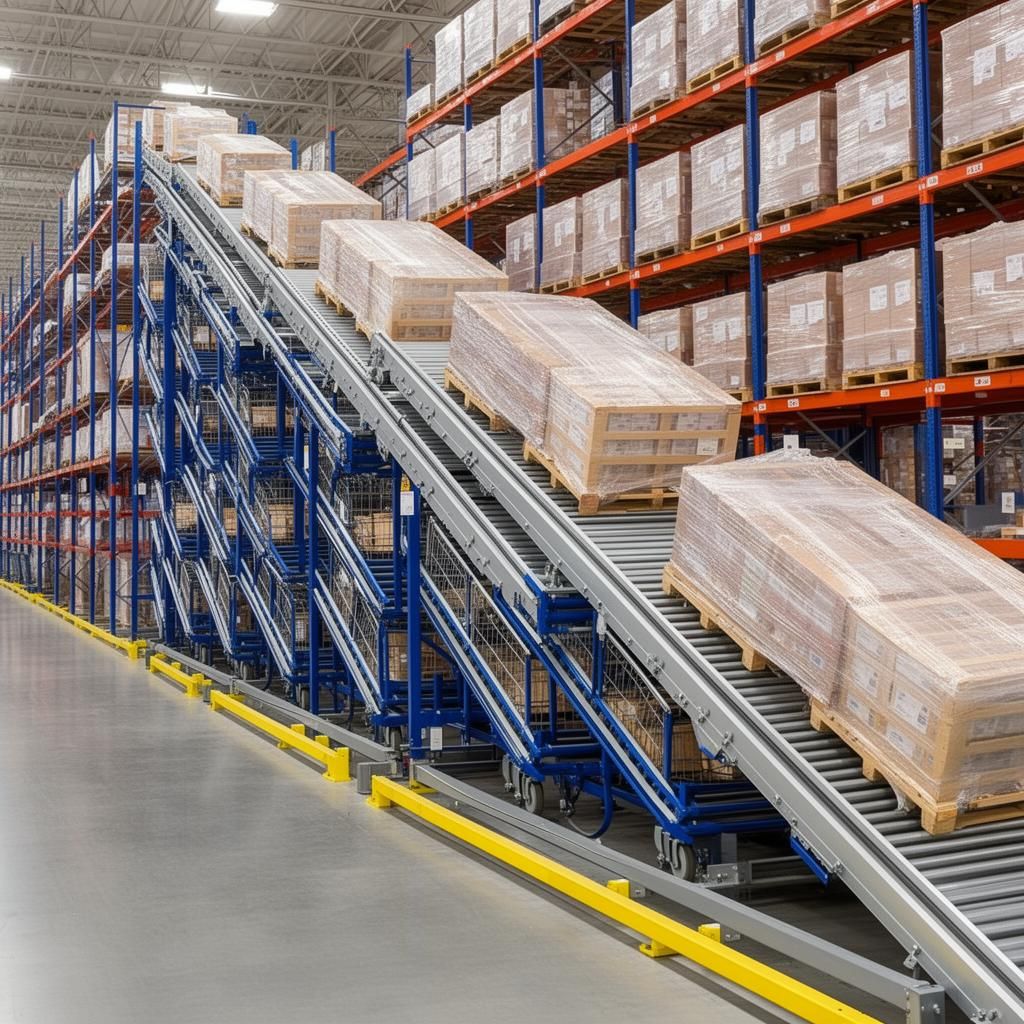
Push back racking systems use a series of nested carts on inclined rails, allowing pallets to be stored up to 6 deep. When a pallet is removed, the remaining pallets automatically roll forward. This LIFO system provides excellent density without sacrificing selectivity.
- Up to 6 pallets deep
- Gravity-fed system
- LIFO operation
- High density with selectivity
Overview
Push back racking is an innovative high-density storage system that combines the density advantages of drive-in racking with significantly better selectivity. Using a series of nested carts on inclined rails, push back systems allow pallets to be stored up to 6 positions deep from a single aisle, with each position automatically feeding forward when a pallet is removed.
The system operates on a Last-In, First-Out (LIFO) basis. When a new pallet is loaded, it pushes the existing pallets back along the inclined rails. When a pallet is removed from the front, gravity causes all remaining pallets to roll forward to the pick face, ensuring that a pallet is always available at the aisle position.
Push back racking is particularly popular in the UAE's FMCG, beverage, and cold storage sectors, where it provides excellent density for products with moderate SKU counts and consistent pallet sizes. Unlike drive-in racking, push back systems do not require forklifts to enter the racking structure, significantly reducing the risk of structural damage and improving operational safety.
System Operation & Mechanics
Push back racking uses a series of telescoping carts that nest together on inclined rails within the racking structure. The rails are angled at approximately 3-4 degrees from front to back, creating a gentle slope that allows the carts to roll forward under gravity.
When loading the first pallet, it is placed on the front cart. The second pallet pushes the first back along the rails to the second position. The third pallet pushes both previous pallets back, and so on, up to 6 positions deep. Each cart nests partially inside the one behind it, allowing efficient use of the available depth.
When unloading, the forklift removes the front pallet. The remaining pallets immediately and smoothly roll forward on their carts, presenting the next pallet at the aisle face. This automatic feed-forward mechanism eliminates the need for the forklift to enter the racking structure, making push back significantly safer and faster than drive-in racking.
Advantages
Key Benefits
High Density with Safety
Achieve density comparable to drive-in racking without forklifts entering the structure, dramatically reducing collision damage and safety risks.
Automatic Feed-Forward
Gravity-powered cart movement ensures the next pallet is always presented at the pick face, eliminating empty aisle travel.
Multiple SKUs per Lane
Unlike drive-in racking where each lane should hold one SKU, push back lanes can store different SKUs at different depths if needed.
Fast Loading & Unloading
Forklift operators never enter the racking structure, enabling faster cycle times and higher throughput than drive-in systems.
Reduced Racking Damage
Since forklifts only operate from the aisle, the risk of structural damage from forklift impacts is virtually eliminated.
Flexible Depth Options
Systems can be configured from 2 to 6 pallets deep, with different depths on different levels within the same bay.
Industries & Use Cases
- FMCG distribution centers
- Beverage warehouses and breweries
- Cold and frozen storage
- Manufacturing finished goods storage
- Retail distribution centers
- Third-party logistics providers
- Pharmaceutical warehouses
- Seasonal product storage
Technical Details
Operational Efficiency Gains
Push back racking delivers measurable efficiency gains over drive-in racking. Because forklifts never enter the structure, operators can load and unload pallets from the aisle in 30-45 seconds per pallet, compared to 60-90 seconds for drive-in operations. This 40-50% reduction in cycle time translates to higher throughput with fewer forklift operators. In a typical 3,000-pallet facility, switching from drive-in to push back racking can reduce labor costs by 15-20% while simultaneously reducing racking damage repair costs by up to 80%.
Engineering & Cart Design
Our push back carts are manufactured from heavy-gauge welded steel with precision-machined wheel assemblies. Each cart undergoes individual load testing before shipment. The nesting design ensures smooth telescoping action even under full load, and the wheel bearings are sealed and lubricated for maintenance-free operation over thousands of cycles. Rail profiles are rolled from structural steel and feature integral wheel guides that prevent cart derailment.
Frequently Asked Questions
Get Your Storage Solution Today
Contact Racking UAE for the best racking and shelving services in Dubai and across the UAE.
Contact Now