Drive-in Racking
Drive-in racking provides high-density storage by allowing forklifts to drive directly into the racking structure. This ...
Drive-in Racking
Drive-in racking provides high-density storage by allowing forklifts to drive directly into the racking structure. This system operates on a last-in, first-out (LIFO) basis and is perfect for bulk storage of homogeneous products with low SKU counts.
- High-density storage
- LIFO operation
- Reduced aisle space
- Ideal for bulk storage
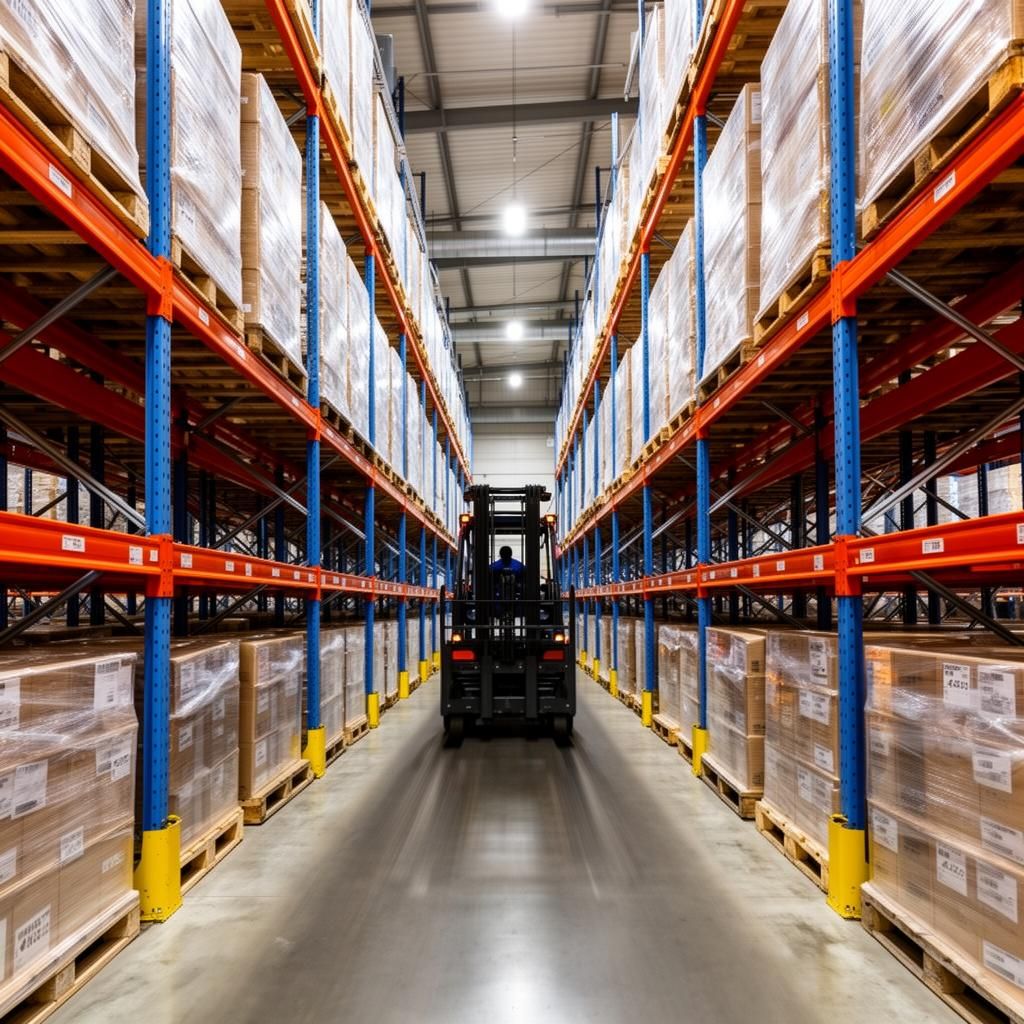
Overview
Drive-in racking is a high-density storage system that maximizes warehouse space utilization by minimizing the number of aisles required. Unlike selective pallet racking where each pallet position is directly accessible from an aisle, drive-in racking allows forklifts to drive directly into the racking structure along guided rails, depositing or retrieving pallets from multiple positions deep within the same lane.
This system operates on a Last-In, First-Out (LIFO) basis, making it ideal for warehouses that store large quantities of the same product (homogeneous inventory) where stock rotation on a per-pallet basis is not critical. Drive-in racking is extensively used in the UAE's food and beverage industry, cold storage facilities, building materials warehouses, and any operation where maximizing storage density is the primary objective.
By eliminating up to 80% of the aisles required in a selective racking layout, drive-in racking can increase your storage capacity by 60-85% within the same warehouse footprint. This translates directly to lower per-pallet storage costs, reduced warehouse rental expenses, and delayed capital investment in warehouse expansion or relocation.
System Operation & Mechanics
Drive-in racking consists of a series of vertical frames arranged in deep lanes, with horizontal rails on each side at multiple heights. Forklifts enter the lane from one end and deposit pallets on the rails, one behind another, building up the depth of each lane from back to front.
The forklift drives into the lane on a guide rail at floor level, which keeps the truck centered and aligned with the pallet positions. The driver lifts the pallet above the first available rail level, drives to the deepest available position, and lowers the pallet onto the rails. Loading typically starts at the deepest position and works forward, while unloading reverses this process—hence the LIFO principle.
Drive-through racking is a variation that allows access from both ends of the lane, enabling First-In, First-Out (FIFO) operation. However, drive-through requires aisles on both sides, which slightly reduces the density advantage. Our engineering team will recommend the optimal configuration based on your inventory management requirements.
Advantages
Key Benefits
Maximum Storage Density
Achieve up to 85% space utilization compared to just 40-50% with selective racking, storing significantly more pallets in the same warehouse footprint.
Reduced Rental Costs
By dramatically increasing storage density, you can store more product in a smaller warehouse, directly reducing your per-pallet rental costs.
Ideal for Cold Storage
The high-density design minimizes the volume of air that needs to be cooled, reducing energy consumption in cold and frozen storage facilities by up to 30%.
Simple Forklift Operation
Guide rails ensure safe and accurate forklift navigation within the lanes, reducing the risk of structural damage and product loss.
Cost-Effective Installation
The relatively simple structural design means lower material and installation costs compared to automated high-density alternatives.
Scalable Depth
Lanes can be configured from 2 to 10+ pallets deep, allowing you to match the system depth to your batch sizes and throughput requirements.
Industries & Use Cases
- Cold and frozen storage warehouses
- Food and beverage distribution centers
- Building materials storage (cement, tiles, bricks)
- Seasonal product storage
- Buffer storage for manufacturing plants
- Paper and packaging material warehouses
- Chemical product storage
- Third-party logistics (3PL) providers
Technical Details
Cold Storage Applications
Drive-in racking is the preferred choice for cold and frozen storage facilities throughout the UAE. The high-density design minimizes the volume of conditioned air within the warehouse, leading to significant energy savings. In a typical -25°C freezer warehouse, switching from selective to drive-in racking can reduce refrigeration energy consumption by 25-35%. We manufacture drive-in racking with materials and finishes specifically rated for continuous operation at temperatures as low as -30°C, ensuring long-term structural integrity in demanding cold chain environments.
Structural Design Considerations
Drive-in racking imposes unique structural demands because the racking structure must withstand both vertical loads (from stored pallets) and horizontal forces (from forklift impacts during entry and exit). Our structural engineers use finite element analysis (FEA) to model load paths, column buckling resistance, and connection stiffness. All uprights feature reinforced base plates with multiple anchor points, and top-tie beams connect the tops of the frames to provide lateral stability. Column protectors and guide rails are designed as sacrificial elements that absorb impact energy without transferring it to the main structure.
Comparison with Other High-Density Systems
While drive-in racking offers excellent density at a relatively low cost, it's important to understand how it compares with other high-density alternatives. Push-back racking offers similar density with easier LIFO access but costs 20-30% more. Shuttle racking provides similar or better density with semi-automated operation, ideal for high-throughput facilities. Mobile racking offers the highest density with full selectivity but requires a higher initial investment. Our consultants will help you evaluate the best option based on your throughput, budget, and operational requirements.
Frequently Asked Questions
Get Your Storage Solution Today
Contact Racking UAE for the best racking and shelving services in Dubai and across the UAE.
Contact Now